Occupy Somewhere Else
Occupy Nashville may ruin it for the rest of us:
As readers recall, we have defended without reservation the constitutional right of those sitting in at the Tennessee Capitol to be there, and we were critical of the Governor and Public Safety Commissioner Bill Gibbons for attempting to evict them. Rights come with responsibilities, however, chief of which is that those exercising a right should conduct themselves with good sense so as not to ruin that same exercise for others who may wish to engage in similar activities in future for other reasons. Governor Bill Haslam's apparent move to modify the use policy of the Capitol grounds, which have traditionally always been open to the public at all times and all hours of the day and night, has its roots not with the Governor's office, but with the frustration of the legislative staff who work at the Capitol every day.
Labels: Blogging, Democrats, Federal politics, Local politics, News Media, Political correctness, Tennessee politics
Open Meetings Act
Revisions to the Tennessee Open Meetings Act should be done sparingly and
handled with great care:
It is true that the chief proposal, which comes out of Williamson County
and is being sponsored in the Tennessee House in the next session by
former House Republican Caucus Chairman Glen Casada (R-Franklin). The
legislation was apparently brought to Casada by the Williamson County
Commission. The proposed change would allow closed-door discussions
among commissioners and other local officials so long as a quorum is not
present. The problem with this approach is that it could too easily be
used to circumvent public input simply by setting up two separate
non-quorum meetings, quietly coming to agreement behind closed doors,
and taking a vote at the public meeting without recourse to free, open,
or public debate. Such a maneuver-however well-intentioned-is a serious
danger to free government wherever it exists and should be discouraged
at all costs.
Labels: Blogging, Conservatism, Democrats, Elections, Local politics, Political correctness, Tennessee politics
Silence Here
The
Knoxville News Sentinel has apparently decided that there is
really no Silence here:
This is yet another example of the declining quality of the News Sentinel and of Scripps newspapers generally. One has to wonder if the News Sentinel will suffer the same fate eventually as the Rocky Mountain News and The Cincinnati Post-which had been the very flagship of the Scripps chain. The Rocky and the Post were good papers, but if the KNS wants
to join them in their fate, cutting your best people from the staff is
not the way to insure viability. In what is likely the last post on his
blog No Silence Here, Michael Silence confirmed via the paper's online staff that the rumors of his departure were true this morning.
Labels: Blogging, Conservatism, News Media, Tennessee politics
No Hiding
When you comment on a major news site, you should stand
by your words with a name:
V=The Examiner now essentially forces commenters to post via their
Facebook accounts, and the number of vitriolic or (for lack of a better
word) just plain ignorant comments seems to have been drastically
reduced, and instead we see thoughtful comments that contribute to the
discussion. E.W. Scripps and the Knoxville News Sentinel ought to
consider adopting a similar policy for their websites. If you believe
in what you are saying, then it shouldn't be something that you are
attempting to hide behind on the internet.
Labels: Blogging, Conservatism
I'm With Kleinheider
The latest victim of the mainstream press attempt to baselessly pick on conservatives has made Tennessee's
most venerable blogger a target:
This writer admits that he has a bias, because like so many bloggers and op-ed writers in Tennessee who have used the internet as a primary vehicle to get their message out to their fellow Tennesseans, and even a national and global audience, he knows A.C. Kleinheider. Before Kleinheider was ever a part of the Lieutenant Governor's staff, he was a blogger first-and was paid to do it. First at Nashville's WKRN, then at the Nashville Post, blogging and aggregating at Post Politics. Kleinheider was the voice of the Tennessee political blogosphere, and no one understands new media the way that A.C. does. Other staffers on both sides of the aisle have admitted that they have had trouble with the lines between State business and the political in positions that are-well, so overtly political.
Labels: Blogging, Conservatism, Democrats, Duh, Elections, Local politics, Presidential Election, Tennessee politics
Censorship That Isn't?
Knoxville News Sentinel editor Jack McElroy plays with semantics about censorship:
To say that the paper doesn't engage in censorship is at the least an exercise in semantics and at the most is a disingenuous statement. The truth is that the News Sentinel is able to censor because it is a private entity, but it does engage in censorship. McElroy and others at the paper can call it what they like, but if it looks like censorship, and it prevents someone from expressing their views, censorship is precisely what it is. Yes, the News Sentinel is free to censor others because it is a private entity. As a community news organ, this right to censor should be exercised not only with a great deal of discernment, but should be done very sparingly-and perhaps only when dealing with foul language. E.W. Scripps may own the News Sentinel, but it is Knoxville's only remaining major newspaper and in a very real sense it belongs to the larger community.
Labels: Blogging, Conservatism, Elections, Local politics, News Media, Political correctness, Tennessee politics
Some Humble Opinions On the British General Election and Aftermath
In the wake of a General Election result in Britain which has left the United Kingdom with a hung Parliament and plenty of political uncertainty, there is no small amount of discussion about what Conservative Leader David Cameron should do. Cameron has offered to make an arrangement for a coalition government with the Liberal Democrats, a move that would have been unthinkable not 72 hours ago:
During one of the most extraordinary days in British political history, the Conservative leader made an unprecedented “big, open and comprehensive offer” to the Liberal Democrats after the election ended in the first hung parliament for 36 years.
To the astonishment of many at Westminster and beyond, Mr Brown stubbornly refused to accept election defeat despite Labour losing almost 100 seats.
Instead, the Prime Minister attempted to woo the Liberal Democrat leader with a power-sharing offer of his own.
After a night in which the Tories had appeared confident of securing an overall majority, Mr Cameron looked shell-shocked as he addressed a press conference at which he outlined a ground-breaking and, until yesterday, unthinkable offer to the Liberal Democrats.
Mr Cameron, who had declared that Labour had lost its right to govern, outlined the areas of policy agreement between the Conservatives and Lib Dems, which offered “a strong basis for a strong government”.
The Tory leader made clear that while he was prepared to offer Mr Clegg concessions on tax, education, climate change and civil liberties he would not move on the crucial policy areas of immigration, Europe and the Trident missile system. He would also only offer the Lib Dems an all-party inquiry into electoral reform.
It has been established even by people within Gordon Brown's own Labour Party that the current Prime Minister is a selfish, arrogant, pompous jackass. He also has no real regard for the results of an election that, while not making the Conservatives the majority party, has clearly made them the largest one. It is as if the British electorate has said with a loud voice "we aren't yet sure if we want the Tories, but we are bloody sure that we don't want you, weasel."
Amidst the discussion of what the Conservatives are to do comes a rather frightening suggestion from former Conservative (defeated) cabinet minister Michael Portillo:
The prospect of ditching the Tory party Right wing is hardly dismaying. A new centre Right grouping (New Conservatives?) would probably find it easier to win under any system than the old Conservatives did on Thursday night. The British people have voted for new politics, and Cameron is poised to deliver it.
Portillo's idea of simply ditching the Conservative Party's actual small-c "conservatives" is workable only if the Conservative Party, which would then not have terribly many conservatives in it, is poised to accept that it may never have a workable majority again. Instead, David Cameron needs to ask himself why it is that his party did not win an outright majority:
Dave had to fight a widely despised Prime Minister leading a Government incompetent and destructive on a scale unseen in living memory. Seldom has there been a softer target; but seldom has one been missed so unnecessarily. With just 36 per cent of the vote, the Tories stood almost still since 2005. They are now on their knees to their other enemy, the Lib Dems.
It should not have come to this. As I rang round Tory MPs some were incandescent at the conduct not just of the campaign, but of the whole anti-core vote strategy that has alienated many natural Tory voters.
But let us not forget that the roots of this problem go back to 2005. The party has chosen to mimic and validate the policies of its opponents, with the result that the public found little to choose between the main parties. This was exemplified in the television debates, in which the leaders fell over themselves to agree not only with any contention put to them by the public, but even with each other.
The party spoke with a clear voice: the voice of neo-Blairism, of flannel, and not a voice of conservative principle. This should not have surprised any reader of this column, for I have long maintained that Mr Cameron is not a conservative. His slogans of social democracy – "hope, not fear" and, of course, "change" – simply presented a warm bath of sentiment to a people who wanted specific details of what would be done to rescue our country from the economic knackers' yard. No wonder it was so straightforward for him to hold out the hand of friendship to the Lib Dems: he almost is one.
The Tory Party needs to articulate not only policy differences with their Labour and Liberal Democrat opponents-something that they do seem to have done effectively when observed from this side of the pond-but real, clear, and sustainable philosophical differences. Some who are familiar with my personal political views and writing may say "now Oatney, it sounds like you are just saying all of this because you are a right-winger yourself." It is a fair point, but I'm saying it because it has a much larger and, in a sense, universal political application. If I have learned anything from my own interaction with politics and my personal political experiences it is that a political party needs both wings to fly. I have real differences with the moderates in my own Republican Party, but I am not so politically naive as to believe that life will become easier for us politically if we just throw the moderates out. You put far more pressure on your right leg when you cut off your left leg. Similarly, if Britain's Conservative Party makes the deadly mistake of cutting off it's "strong Right arm," it will be left with a weakened Left arm that won't look terribly much different to voters than Labour, or even the Liberal Democrats. Power means little to decent people without real principles behind it.
The well-exposed Conservative Member of the European Parliament Daniel Hannan thinks that a deal for a coalition government with the liberal Democrats is a real possibility under the circumstances:
Is it possible to reach an accommodation with the Lib Dems based on fiscal tightening? I think so. The two parties are divided over timing, not principle. On the campaign trail, Nick Clegg claimed that deferring the cuts was a whizz-bang piece of Keynesian pump-priming. But he is privately aware that postponement will make the cuts more painful when they come – as the Greeks are now discovering. With polling day out of the way, Cleggie no longer has any reason to deny the truth.
Both parties, meanwhile, want to scrap ID cards and reverse some of the more statist legislation passed by Labour in the guise of anti-terrorism measures. Both agree that our political system needs renewal. Both want recall mechanisms, popular initiative procedures, reform of the Upper House, fewer MPs, a shift in power from Whips to backbenchers and from executive to legislature. These things would have a far more tangible and benign impact on our political system than proportional representation.
Proportional representation is the hue and cry of political formations the world over-both those on the Left and on the Right-that can't win a free and fair election if they tried to buy one. Britain's Liberal Democrats have proven that even with better political leadership, they still don't have anything remotely approaching the confidence of the electorate in that country, so proportional representation is their only hope to amount to anything. The Conservatives are right to resist the idea unless they want to be left trying to cobble together coalitions in future with the likes of the British National Party, which could win seats under a proportional representation scheme.
To govern as Prime Minister in the present, however, David Cameron will need a coalition with his other political rivals, the Liberal Democrats. The wise thing to do would not be to sell out on proportional representation, but to accomplish electoral reform in other ways, such as more even constituencies to give votes an equal weight. Oh, and a real referendum on membership in the European Union, one that Euro-skeptics may very well win, is something Cameron and the Conservatives should consider to make themselves truly distinguishable from Labour or the Lib Dems.
David Cameron has an excellent chance to use coalition government to show the British public why the Conservatives should again be given a chance to govern Britain outright-if he doesn't blow it.
Just a few humble thoughts from the other side of the water...
Labels: Blogging, Conservatism, Foreign policy, Miscellany, News Media
Are These Results Surprising?
Are these results something that surprise those of you who are regulars to this weblog?
My Political ViewsI am a right moderate social libertarian
Right: 3.24, Libertarian: 1.19
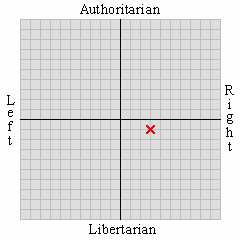 Political Spectrum Quiz
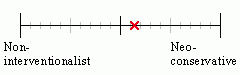
I have to admit that I found this next result a little surprising...
My Foreign Policy ViewsScore: 1.48
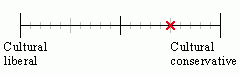
I scored well as a Culture Warrior, due in large part to my pro-life views.
My Culture War StanceScore: 4.98
Labels: Blogging, Conservatism, Faith
Do We Care About Conduct?
Tom Humphrey wonders if Tennesseans
have become desensitized to the "sex scandals" of our political leaders because "it happens all the time."
Once upon a time, say a couple of decades ago, there was a lot of gossip in Tennessee political circles about inappropriate sexual activity but it rarely, if ever, made its way into media reports.
Today, on the other hand, we find two gubernatorial candidates dealing - on a rather indirect or tangential basis, of course - with publicized adultery allegations.
For Lt. Gov. Ron Ramsey, the tangent has been Sen. Paul Stanley, R-Germantown, who last week resigned his Senate seat after acknowledging to the TBI that he had a sexual relationship with a 22-year-old intern.
Ramsey had appointed Stanley chairman of the Senate Commerce Committee. He was caught by surprise, the Senate speaker says.
After the scandal became public, Ramsey says he prodded Stanley to, first, resign as chairman and, second, to resign from the Senate.
There is no evidence to suggest that Ron Ramsey knew about Paul Stanley's relationship with his intern for any longer than Ramsey himself says that he knew. Similarly, as Humphrey points out, certain media and Democratic shill outlets trying to make connections between Republican gubernatorial candidate Rep. Zach Wamp and disgraced Congressman John Ensign where none exist based solely on a campaign contribution from Ensign's PAC-and the fact that the two men shared a place in Washington with other Members of Congress who were people of faith-are also trying to make a mountain out of a molehill. Humphrey brings up a much deeper question, however, and that is whether the voters even care about political figures' sexual indiscretions.
The state's Democrats, meanwhile, have generally kept quiet about Stanley's steamer.
Former Rep. Rob Briley, D-Nashville, resigned his committee chair after a drunken-driving arrest that led to disclosure of an apparently inappropriate relationship. But he served out his regular term.
For me, the issue with Rob Briley was not that he was apparently having loads of fun with a lobbyist for the Tennessee Trial Lawyers' Association (an oddly appropriate match for Briley). Titilating information, to be sure, but that probably didn't impact Briley's ability to do his job in the Legislature on its face-especially since he already saw the Legislature as his personal club of sorts. It
probably did have an impact on the lobbyist's ability to do her job, but that was settled between her and her employer. The difficulty in the Briley case is that his relationship with
Mary Littleton was also a part of a larger life problem that
was impacting his job. Rob Briley wasn't just an alcoholic, but his addiction had become dangerous and placed his life, his work, his constituents, and his health all in jeopardy. Hindsight being 20/20, we now know that part of the reason for Briley so often appearing mean, hateful, uppity, snobbish, and downright rude was that this was the liquor talking, we may never know what an alcohol-free Briley would have been like. Since Briley left, several legislators have mentioned to me that part of the reason Briley was the way that he was had to do with his excessive drinking.
Briley
blamed bloggers for his ouster, but he had problems that may have been inherited. It is said that his
Grandfather was a pretty mean drinker in his own right. Regardless of all of the reasons for his leaving, Briley could not effectively represent his constituents, and he needed to go.
While some people really do expect their political leaders to be perfect, the most reasonable expectation is not perfection, but that these officials not engage in behavior that could negatively affect their jobs-and they
should have the good sense to know what that kind of conduct might be.
Labels: Blogging, Conservatism, Democrats, News Media, Political correctness, Republican Party, Tennessee politics
The Decline of the Daily
My favorite Knoxville News-Sentinel columnist, Greg Johnson, laments the decline of newspapers today:
The demise of newspapers has not been greatly exaggerated. The News Sentinel's sister paper in the E.W. Scripps chain, the Rocky Mountain News, folded its final edition recently. The Detroit Free Press has cut home delivery to three days per week.
Over the six-month period ended in March, average newspaper sales declined more than 7 percent.
The reason is familiar: People are reading online. So the shots in "State of Play" and "The Soloist" of that archaic, if fascinating, process of applying ink to paper seem a premature eulogy of sorts, early requiems for a time when we were able to smudge our fingers as we eased into the day while perusing our favorite rag.
As Johnson points out, technology has played no small part in this decline of the old news rag. It isn't really blogging that has brought about the demise of so many papers, but the fact that so many people are reading the papers online. Over the last couple of years, this space has lamented the end of The Cincinnati Post and The Rocky Mountain News, but the end of newsprint papers is not the problem with the demise of these media organs, but the end of two-paper towns and competative journalism. Not everyone reads the paper on the internet, and not everyone surfs the blogs, or even knows what that expression means. Eventually, our society will likely get to a place where those ways of obtaining news and opinion are commonplace, but until they do, the loss of variant editorial voices to the reading populace has the potential to create a more serious information gap than exists between those with regular access to the internet and those without that capability.Labels: Blogging, News Media
A Rocky Future for Newspapers?
Lent is a time for serious reflection and spiritual renewal, and it can be a time for reordering of a person's life priorities. Certainly it is becoming this for me. It can also be a period of serious shock, when a person comes to understand that things cannot remain as they are. Such is the feeling, I would imagine, of people at The Rocky Mountain News on Thursday and Friday. E.W. Scripps closed Colorado's first newspaper-a property that it owns-yesterday, citing the economic reality that it could not afford to maintain The Rocky at a loss when The Denver Post appears unwilling to continue its role in the Denver Newspaper Agency in the fashion that it has in the past. I first heard the news Thursday from Tennessee GOP Communications Director Bill Hobbs, whose dream job in the world of journalism was once to work at The Rocky Mountain News.It hit home primarily because the announcement brought about a deja-vu of sorts of the kind that I felt when I heard that The Cincinnati Post had gotten the axe from Scripps because The Cincinnati Enquirer decided not to continue a long-standing joint operating agreement with Scripps. The Post was the first Scripps newspaper, and was the company's flagship publication. When I lived in Cincinnati, I wanted badly to wipe my rear end with The Cincinnati Post on a daily basis. However, I thought the very existence of the Post made the Enquirer a better newspaper. Further, on those rare occasion that the Post was right in an editorial sense, they were very right.The Rocky Mountain News was different than the Post. I read it online occasionally, and it is a great paper, something sorely missing in today's market. Well-written stories, hard news, and solid editorials that leave readers asking questions and writing letters. Further, the tabloid format it published in makes it handy to read and portable. The Rocky should probably have been seen as the new flagship-the jewel in the Scripps crown with the demise of The Cincinnati Post.I watched the short film Final Edition at The Rocky's website. On it, investigative reporter Laura Frank seems to allude that bloggers and blogs are at least part of the reason we are seeing newspapers in such trouble-and they are in real trouble. While I am sure blogs play a small role in the newspaper crisis, I didn't begin to cover Tennessee politics here in an attempt to compete with the Knoxville News-Sentinel. Instead, I write to offer both my unique perspective, and an alternative editorial voice to the News-Sentinel and The Tennessean. Those papers have staff that can put out tens and hundreds of stories a day. I write one or two editorial posts a day, perhaps more when I am at the Legislative Plaza in Nashville. I do what I can, but I am a staff of one.Truthfully, this crisis has much more to do with newspapers' ability to successfully make a transition that is profitable from print to digital and online news production. We live in an age when the news is available free to anyone, even local news. Why should people pay for what they can get for nothing? Newspapers must learn how to make online advertizing work in a way that keeps them afloat. It is often forgotten that The Denver Post is in serious financial trouble, and there are rumors that The San Francisco Chronicle may close. It won't be long before one-newspaper towns with respected news outlets begin to lose those papers as well. That being the case, and Scripps admitting in the midst of its sale of The Rocky Mountain News that its newspaper division is in a very serious financial situation, it is fair to ask: Will the Knoxville News-Sentinel be around for all that long?Labels: Blogging, Conservatism, Faith, Miscellany, News Media


